







Ethical textile manufacturing across Portugal, Spain and the Netherlands — EU labour standards and an audit-ready supply chain
Technology · Ethical manufacturing

Ethical manufacturing is a supply chain, not a tagline.

Most textile production claims to be ethical; the real definition is harder. EU labour standards at every step, certified raw materials with third-party verification, traceable workshops and audit records a procurement team can actually read — no greenwashing, no offshored labour shortcuts, no sub-supplier opacity. Here’s what that means at Fabrixa.

EU labour standards · Audit-ready · OEKO-TEX / GOTS · No sub-supplier opacity

Definition

Three things have to be true at once.

“Ethically made” carries no legal definition, so the burden falls on the producer to prove it with specifics. The honest version needs three things true at the same time — not one of three, not two. All three hold for print on demand produced in Europe.

01
People
Verifiable end-to-end

Every workshop in the chain — mill, dyer, printer, cut-and-sew — operates under EU labour law: documented contracts, regulated hours, paid overtime, occupational-health protection. No subcontracting to opaque second-tier facilities.

02
Materials
Certified, not assumed

Cotton certified GOTS organic from seed to finished textile. Auxiliary chemicals on the OEKO-TEX whitelist. Dye chemistry tested for residual load. No green-coded packaging wrapped around uncertified content.

03
Traceability
Survives an audit

Every shipment carries certification references that resolve to verifiable third-party audit records. Procurement can pull the chain of custody on any batch and see who handled the cotton at every stage.

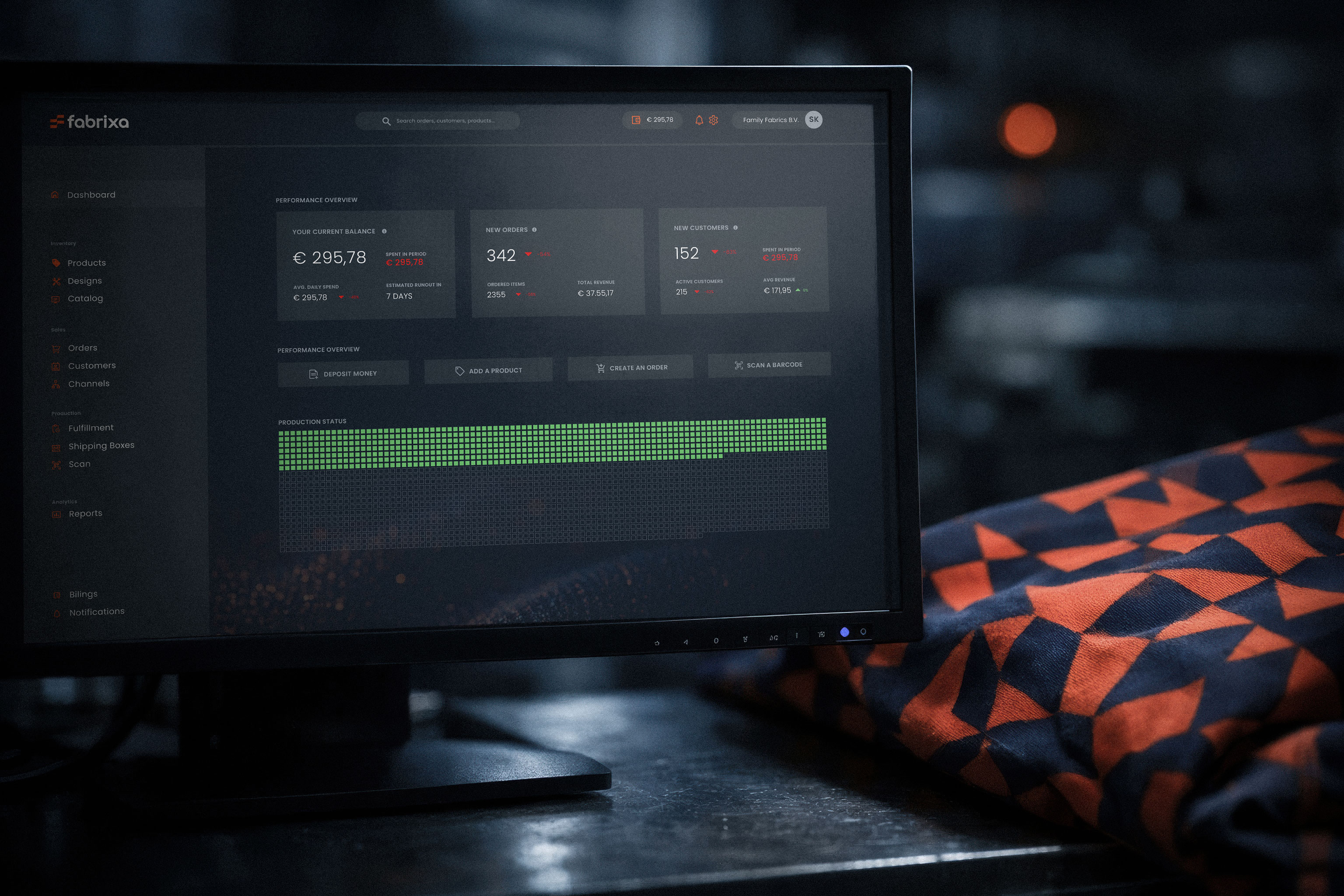
Reactive-printed cotton on the steam-fixation line in an EU production facility
EU labour standards

The European baseline is the floor, not the goal.

Fabrixa production runs through workshops in Portugal, Spain and the Netherlands — all under EU labour law: minimum wage indexed to cost of living, statutory contracts, regulated working hours, guaranteed annual leave, enforced health and safety, and the right to unionise. These aren’t aspirational. They’re enforced by national labour inspectorates with audit access, and the cost of compliance is in the per-unit price — we don’t move production somewhere cheaper to dodge it.

  • Working hours — 40-hour standard week, regulated overtime, statutory rest periods and annual leave.
  • Wages — minimum wage indexed and reviewed annually, above industry minimums for skilled textile work.
  • Occupational health — mandatory regime per workshop: PPE, ventilation, machine-safety inspection and documented incident reporting.
What we won’t do

The shortcuts the industry takes that we don’t.

Plenty of suppliers advertise “ethical” while relying on practices that wouldn’t survive scrutiny. These are the lines we hold — even when they cost us margin or speed.

We don’t

Offshore labour arbitrage

Move cut-and-sew to lower-wage jurisdictions outside EU labour law to drop the per-unit cost. Our whole chain stays inside the EU because the labour standard is the point.

We don’t

Opaque sub-contracting

Place production with a tier-1 partner who quietly subcontracts to undisclosed tier-2 workshops. We work directly with named workshops we’ve audited.

We don’t

Greenwashing language

“Eco-conscious”, “planet-positive” copy with no third-party certification behind it. We state what we’ve certified, not what we’d like to be.

We don’t

On-paper compliance

Produce certificates for the purchase decision but operate differently on the floor. The audits we cite are live, recently dated and trace to known certification bodies.

We don’t

Chemistry obfuscation

Use uncertified dye auxiliaries while citing OEKO-TEX on the fabric base. Our reactive print chemistry is OEKO-TEX-listed end-to-end, not just the cotton it sits on.

We don’t

Forecast-and-dump waste

Build inventory on speculative forecasts and landfill the unsold stock. The platform is on-demand by design — we make what’s ordered.

The supply chain

Stage by stage, where the people are.

Every stage produces records a procurement team can request and audit. Here’s the path a single Fabrixa garment takes from raw fibre to dispatch.

01
Cotton
GOTS-certified

Organic cotton from chain-of-custody-tracked partners. Origin documented, non-GMO, pesticide-free farming verified on GOTS audit cycles.

02
Weave / knit
EU mills

European mills in Portugal and Spain under EU labour standards. Mercerised, enzyme-washed and sanforised under controlled, OEKO-TEX-listed processes.

03
Print
Reactive AOP

Industrial reactive all-over print in Portugal. Bio-based dye chemistry, low-discharge process, OEKO-TEX-compliant residual limits.

04
Cut & sew
EU workshops

EU workshops with documented contracts, regulated hours, paid overtime and statutory health protection. Workers can speak to inspectors freely.

05
QC + pack
White-label

Per-unit QC pass and white-label packaging assembled in-house. A documentation pack — certs, batch refs, care guide — ships with every order.

Documentation

What ships with every Fabrixa order, and what unlocks on request.

Ships by default

Audit-ready paper trail with every order:

  • OEKO-TEX Standard 100 certificate reference per fabric base
  • GOTS chain-of-custody reference for organic-cotton bases
  • Country-of-origin and EU labour-standards declaration
  • Per-batch production reference (traceability resolves to the workshop)
  • Care-label translation and dye-residual compliance summary
Unlocks on request

For ESG, procurement & buying-team review:

  • Quarterly or annual supplier audit trail
  • Workshop-level labour-standards declaration
  • Per-SKU carbon-footprint estimate for ESG reporting
  • Master Supply Agreement covering ethical commitments
  • Ethical-supply-chain declaration for retail compliance
The trade-off

The per-unit price reflects the labour standard.

EU production costs more per unit than equivalent work in lower-wage jurisdictions. That’s not a loophole to fix — it’s the labour-standard premium working as intended. The wage, the social-security contributions, the regulated hours and the occupational-health overhead all flow into the cost. Brands that compete on a transparent supply chain accept the delta because their customers pay for it — directly through retail price, or indirectly through trust over time.

The cheaper route

The quiet cost it carries:

  • EU Customs Modernisation Code due-diligence exposure
  • Forthcoming CSRD supply-chain disclosure requirements
  • Reputational risk if upstream practices surface
  • Sea-freight carbon footprint far higher than EU production
  • Currency and tariff exposure on long supply chains
The EU premium

What it buys you:

  • An audit trail that survives ESG and retail-compliance review
  • On-demand production with no speculative-forecast waste
  • Short EU lead times instead of long sea-freight chains
  • A supply chain you can put your brand’s name behind
For procurement & ESG teams

Ask us for the audit trail.

Evaluating Fabrixa as a supplier? Request the full ethical-supply-chain documentation pack — certifications, audit records, workshop declarations, dye-chemistry compliance — before you place the first order. We send it within 48 hours.