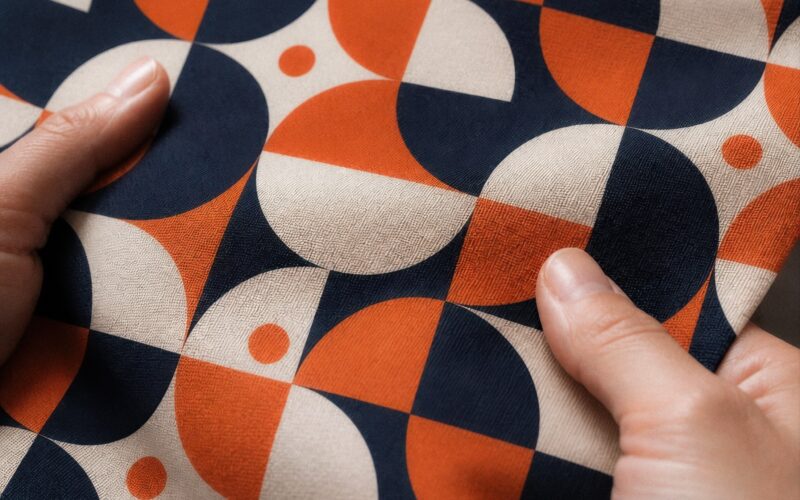












Cotton vs linen printing comes down to fibre structure, not chemistry. Both are cellulose fibres, so reactive dye forms the same covalent bond in each and the colour becomes part of the fibre rather than a layer on top. What differs is how each fibre shows that colour: cotton’s short, uniform fibres render crisp, even and saturated, while linen’s long, irregular, slubbed fibres scatter light, so the same artwork reads softer, more matte and visibly textured.
The short answer: choose cotton when the artwork needs precision and saturation; choose linen, or a cotton-linen blend, when texture and a natural, lived-in character are part of the design.
Same chemistry, different fibre
Reactive printing works on cellulose. The dye is printed onto the fabric and fixed under heat and steam, forming a covalent bond with the cellulose in the fibre — the colour becomes a permanent part of the material, with no surface layer, so the fabric feels like unprinted cloth and the colour typically holds for 600+ wash cycles. The process is explained step by step on our reactive printing page.
Cotton and linen are both cellulose, but they are different plants and different kinds of fibre. Cotton is a seed fibre: short, fine, relatively uniform hairs that grow around the seed of the cotton plant. Linen is a bast fibre: long strands taken from the stem of the flax plant, with the natural thickenings — slubs — that give linen its recognisable look. The dye bonds identically in both; the fibre shape decides what your eye sees afterwards.
Cotton vs linen printing: what changes on the fabric
| Cotton | Linen | |
|---|---|---|
| Fibre source | Seed fibre of the cotton plant | Bast fibre from the stem of the flax plant |
| Fibre structure | Short, fine, uniform | Long, thicker, irregular, with natural slubs |
| Reactive dye bond | Covalent bond with cellulose — colour inside the fibre | Identical covalent bond — colour inside the fibre |
| How colour reads | Crisp, even, saturated; the weave sets the finish | Softer, more matte; slubs show through solid areas |
| Fine detail | Holds fine lines and small type | Texture softens fine lines; suits bolder marks |
| Hand-feel | Soft from day one | Crisper at first, softens with use and washing |
| Creasing | Recovers more readily | Creases easily — part of the look |
| Wash-fastness | Colour holds for the life of the fabric | Colour holds for the life of the fabric |
| In the Fabrixa range | Seven cotton bases by the metre; apparel and most home textiles | 90% cotton / 10% linen blend on duvet covers and bed spreads, made in Spain |
How cotton takes colour
Cotton’s uniform fibres absorb reactive dye evenly, so flat colour fields print flat and gradients stay smooth. From there, the construction sets the finish: Percale’s tight plain weave gives matte clarity, Sateen’s satin weave reflects more light so the same file reads deeper and more saturated, and Half Panama adds a visible basket-weave texture. On apparel knits such as Jersey 220 and French Terry, the same in-fibre colour moves and stretches with the garment. All seven bases in our custom printed fabric by the metre range are cotton.
How linen takes colour
Linen bonds the dye just as permanently, but its long, irregular fibres and slubbed yarn scatter reflected light instead of returning it evenly, so colour reads a touch softer and more matte than the same file on cotton. Reactive printing lays down no white ink — the lightest tone in any design is the fabric itself — so linen’s texture shows through solids and pale areas alike. Designers who choose linen usually want exactly that: a botanical, painterly or heritage look where a little irregularity adds depth.
At Fabrixa, linen enters the range as a 90% cotton / 10% linen blend on duvet covers and bed spreads, reactive printed in Spain alongside the Percale and Sateen versions. The blend keeps cotton’s even dye uptake and softness while the linen share adds a lightly textured, slubbed face that softens further with use.
Which base should you choose?
- Photographic artwork, fine linework, small type, saturated brand colours — cotton. Percale for clarity, Sateen for depth.
- Painterly, botanical, tonal or heritage designs — the linen blend. The texture becomes part of the artwork rather than fighting it.
- Apparel — cotton knits. Jersey for tees and dresses, French Terry for hoodies and joggers.
- Bedding — either. Percale, Sateen and the cotton-linen blend print from the same artwork file; the choice is about look and hand-feel, not durability.
- Undecided — print the same file on both and compare in daylight. With MOQ 1, a single duvet cover in each base is a valid test.
Preparing artwork for cotton and linen
You don’t need two files. Send the artwork you have — PDF, TIFF, JPG or PNG, at around 200–300 DPI on the finished product — and Fabrixa creates the correct print files for each base. What to expect when the same design runs on both:
- Very fine lines and small type hold on Percale or Sateen but soften on the linen blend. If linen is the target, give linework a little more weight.
- Large flat colour fields look slightly more matte and less uniform on linen. That is the fibre, not a print fault.
- Screens show backlit RGB; fabric reflects light. A printed swatch viewed in daylight is the final word on either base — the reactive print guide covers colour expectations in depth.
FAQ
Does reactive printing work on linen?
Yes. Linen is a cellulose fibre, so reactive dye forms the same covalent bond in linen as in cotton. The colour becomes part of the fibre and holds for the life of the fabric.
Why does the same colour look softer on linen than on cotton?
Linen’s long, irregular fibres and slubbed yarn scatter reflected light, while cotton’s uniform fibres return it evenly. The dye is identical; the fibre surface changes how much of the colour reaches your eye.
Can you print on a cotton-linen blend?
Yes. Both fibres are cellulose, so a blend takes reactive dye as one fabric. Fabrixa prints a 90% cotton / 10% linen blend on duvet covers and bed spreads, made in Spain.
Is linen more durable than cotton for printed products?
For the print itself there is no difference: reactive colour lasts as long as the fabric in both. The fibres age differently — linen creases more and softens with washing, cotton is soft from day one — so choose on look and hand-feel.
See the difference on real cloth
The surest way to settle cotton vs linen is to print the same artwork on both and compare in daylight. With MOQ 1 you can order a single duvet cover in Percale, Sateen and the cotton-linen blend, or a metre of any cotton base, before committing to a collection. For a recommendation on a specific design, talk to our team.